
Natural Ways to Sleep Better: Simple Sleep Support Strategies That Actually Make Sense
Have you ever gone to bed feeling completely exhausted, only to discover that your brain seems to have other plans?
You turn off the lights.
Put your phone down.
Close your eyes.
And then suddenly your mind starts reviewing everything that happened during the day.
You think about tomorrow’s responsibilities.
You remember an unfinished task.
You check the clock.
You turn over.
And somehow, another 30 minutes have disappeared.
If this sounds familiar, you’re not necessarily looking for a stronger sleeping pill or a complicated nighttime routine.
Sometimes, the better starting point is much simpler:
Create conditions that make it easier for your body and mind to transition into sleep.
That means looking at your daily schedule, evening habits, bedroom environment, caffeine intake, stress levels, and the way you spend the final hour before bed.
The good news is that many of these changes don’t require expensive equipment or complicated programs.
In this guide, we’ll look at practical natural ways to sleep better, explain why they may help, and show you how to build a realistic nighttime routine that you can actually maintain.
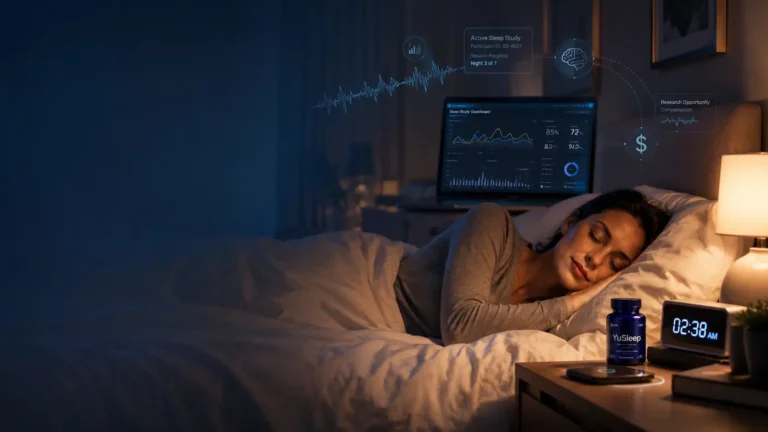
What Does “Natural Sleep Support” Actually Mean?
Natural sleep support doesn’t necessarily mean taking herbs, supplements, or drinking a special tea before bed.
That’s one of the biggest misunderstandings around the subject.
Natural sleep support is better understood as creating habits and environmental conditions that support your body’s normal sleep process.
That can include:
- Keeping a consistent sleep schedule
- Creating a relaxing bedtime routine
- Reducing bright light at night
- Managing caffeine
- Getting daylight during the day
- Staying physically active
- Keeping your bedroom comfortable
- Practicing relaxation techniques
- Reducing stimulating activities before bed
- Giving yourself enough time to sleep
The National Heart, Lung, and Blood Institute recommends several of these habits, including keeping consistent sleep and wake times, using the hour before bed for quiet time, avoiding caffeine and nicotine close to bedtime, staying active during the day, and keeping the bedroom quiet, cool, and dark.
So before searching for a “magic” sleep solution, it makes sense to examine the basics.
1. Build a Consistent Sleep Schedule
One of the simplest—and most overlooked—ways to support better sleep is consistency.
Try to go to bed and wake up at roughly the same time each day.
That doesn’t mean you have to live your life according to a perfectly rigid schedule.
But if your bedtime changes dramatically every night, your body has less predictable information about when it should be preparing for sleep.
For example:
Monday: 10:30 PM Tuesday: 1:00 AM Wednesday: 11:15 PM Thursday: 2:00 AM Friday: 1:30 AM
That’s a very different pattern from:
10:45 PM → 10:45 PM → 11:00 PM → 10:45 PM
Your goal isn’t perfection.
Your goal is predictability.
NHLBI specifically recommends going to bed and waking up at the same time each day and keeping weekend differences relatively small because large changes can disrupt the body’s sleep-wake rhythm.
Try this tonight
Choose a realistic bedtime that gives you enough opportunity for sleep.
Then choose a wake-up time you can maintain most days.
Start there.
2. Create a 30–60 Minute Wind-Down Period
One of the biggest mistakes people make is treating bedtime like a switch.
They’re working one minute and trying to sleep the next.
Your brain may need a transition.
Think about your evening like this:
Work → stimulation → transition → relaxation → sleep
rather than:
Work → bed → sleep
During the final 30–60 minutes, try switching to lower-stimulation activities.
For example:
- Reading a physical book
- Taking a warm bath or shower
- Listening to calm music
- Gentle stretching
- Preparing your clothes for tomorrow
- Journaling
- Practicing slow breathing
- Sitting quietly with dim lighting
NHLBI recommends using the hour before bed for quiet time and specifically mentions relaxation techniques and a hot bath as options.
The goal isn’t to create a perfect ritual.
The goal is to send your brain a consistent signal that the day is ending.
3. Reduce Bright Light and Manage Screen Time at Night
Your environment gives your brain information.
Light is one of the strongest signals involved in your sleep-wake rhythm.
That’s why a bright room at midnight can feel very different from a dark, quiet bedroom.
NHLBI recommends avoiding bright artificial light close to bedtime because it can signal to the brain that it’s time to remain awake.
You don’t necessarily need to live in total darkness two hours before bed.
Instead, experiment with:
- Lowering room brightness
- Using warmer lighting
- Reducing screen brightness
- Avoiding unnecessary overhead lights
- Keeping the bedroom dark when sleeping
This is especially useful if you spend the evening surrounded by bright screens and lights.
Screens deserve their own mention
Phones, tablets, laptops, and TVs don’t just keep your eyes open—they keep your brain engaged. Scrolling, notifications, and fast-changing content can be just as stimulating as the light itself.
A practical middle ground, rather than an all-or-nothing screen ban:
- Set a “last scroll” cutoff 30–45 minutes before bed
- Move notifications to silent or do-not-disturb
- Swap the last screen activity for something passive, like an audiobook or podcast at low volume
- If you do need a screen before bed, keep the content low-stakes (nothing work-related or emotionally charged)
4. Be Careful With Caffeine Timing
Here’s something many people overlook:
The coffee you drink in the afternoon may still matter at bedtime.
Caffeine is a stimulant, and NHLBI notes that its effects can last for several hours—potentially up to about eight hours in some people.
That means your 4 PM coffee isn’t necessarily “gone” by 10 PM.
Of course, sensitivity varies.
One person might drink coffee after dinner and sleep normally.
Another person might have one cup at 3 PM and still struggle to fall asleep.
So rather than following a universal rule, pay attention to your own pattern.
A simple experiment
For one week:
Track your last caffeine intake.
Then compare it with:
- How quickly you fall asleep
- How often you wake up
- How rested you feel the next morning
You may discover a pattern you hadn’t noticed.
5. Make Your Bedroom Sleep-Friendly
Your bedroom doesn’t need to look like a luxury hotel.
It simply needs to support sleep.
Think about three things:
Temperature
A bedroom that’s too hot can make it harder to get comfortable.
Noise
Unexpected sounds can interrupt your sleep or make it harder to settle down.
Darkness
Bright light can interfere with the signals that help regulate your sleep-wake rhythm.
NHLBI recommends keeping the bedroom quiet, cool, and dark.
You can experiment with:
- Blackout curtains
- Eye masks
- Comfortable bedding
- Fans or white noise
- Lower room temperature
- Removing unnecessary lights
You don’t need to buy everything.
Start with the one thing that seems to bother your sleep most.
6. Try a Simple Relaxation Technique Before Bed
This is where relaxation before bed becomes particularly useful.
There are several approaches you can experiment with.
Deep breathing
Slow your breathing and focus your attention on the movement of your breath.
Progressive muscle relaxation
Gently tense and then relax different muscle groups.
Guided imagery
Imagine a peaceful scene and focus your attention on the details.
Meditation
Use your attention to observe thoughts without actively chasing them.
Gentle stretching
Use slow, comfortable movements to transition away from the day’s physical tension.
NCCIH describes several relaxation techniques, including progressive muscle relaxation, guided imagery, biofeedback, self-hypnosis, and breathing exercises.
However, it’s important not to oversell them.
Relaxation techniques may help some people, but the evidence isn’t strong enough to say that they independently solve chronic insomnia. NCCIH notes that the evidence for relaxation techniques alone is limited, while CBT-I has stronger support for chronic insomnia.
So think of relaxation as a supportive habit, not a guaranteed cure.
7. Give Your Brain Somewhere to Put Tomorrow’s Thoughts
Sometimes the problem isn’t that you’re not tired.
It’s that your brain doesn’t want to stop planning.
You lie in bed thinking:
“Don’t forget to send that email tomorrow.”
Then:
“I need to pay that bill.”
Then:
“What if I forget?”
Now you’re mentally working again.
A simple strategy is to create a short brain-dump routine before bed.
Take a piece of paper and write down:
- Tomorrow’s important tasks
- Things I’m worried about
- Things I don’t want to forget
You aren’t solving everything.
You’re simply giving your brain somewhere to store it.
Then tell yourself:
“I don’t need to solve this tonight.”
For some people, that small mental boundary can make the transition to bedtime feel less demanding.
8. Get Daylight and Physical Activity (and Mind Your Workout Timing)
Better sleep isn’t only about what happens at night.
Your daytime behavior matters too.
NHLBI recommends spending time outside and being physically active during the day when possible.
This creates an important principle:
Don’t think only about your bedtime routine.
Think about your 24-hour sleep environment.
During the day:
- Get natural daylight
- Move your body
- Stay physically active
- Avoid spending the entire day indoors if possible
- Keep your daily schedule reasonably consistent
A note on timing
Regular exercise is one of the most consistently supported habits for better sleep, but when you exercise can matter as much as whether you exercise. Vigorous workouts raise your heart rate, body temperature, and alertness—useful during the day, less useful an hour before bed.
If you notice that evening workouts leave you wired rather than tired, try shifting intense sessions earlier in the day and saving lighter movement, like a walk or gentle stretching, for the evening.
Then, as evening approaches, gradually reduce stimulation.
This creates a clearer difference between:
Day = activity
and
Night = recovery
9. Watch Your Evening Meals
What and when you eat in the evening can also shape how well you sleep.
A few patterns worth paying attention to:
- Heavy or rich meals close to bedtime can cause discomfort or indigestion that makes it harder to settle down
- Spicy or acidic foods late at night may trigger reflux in some people
- Going to bed hungry can be just as disruptive as going to bed too full
- Large amounts of fluids right before bed can lead to nighttime waking
A reasonable approach is to finish your main meal a couple of hours before bed, and if you need something later, keep it light.
This isn’t about strict rules—it’s about noticing whether your evening eating pattern lines up with how you sleep.
10. Be Thoughtful About Naps
Naps aren’t inherently bad, but the wrong nap at the wrong time can work against your nighttime sleep.
A few general patterns:
- Long or late naps can reduce your body’s natural drive to sleep at night, making it harder to fall asleep on schedule
- Short naps earlier in the day (often cited as roughly 20–30 minutes) are less likely to interfere with nighttime sleep for most people
- If you’re already struggling to sleep at night, cutting naps out entirely for a week is a useful experiment to see if it helps
As with caffeine, individual tolerance varies. Some people nap daily with no issue; others find that even a short nap pushes their bedtime later. Pay attention to your own pattern rather than assuming naps are automatically helpful or harmful.
11. Be Careful With Alcohol as a “Sleep Aid”
Some people assume alcohol helps them sleep because it can make them feel drowsy.
But falling asleep faster isn’t necessarily the same thing as getting better-quality sleep.
NHLBI advises avoiding alcohol before bed and notes that while alcohol may make falling asleep easier, it can lead to lighter sleep and increase the likelihood of waking during the night.
So if you’re using alcohol specifically because you believe it helps you sleep, it’s worth reconsidering that strategy.
A better approach is to build a routine that actually supports your natural transition into sleep.
12. Don’t Turn Sleep Into a Performance Test
This is a psychological point that doesn’t get enough attention.
Imagine you get into bed and immediately think:
“I MUST fall asleep now.”
You check the clock.
11:45.
Then:
12:05.
Then:
12:27.
Now you’re calculating:
“If I fall asleep right now, I have only six hours left.”
That creates more frustration.
And more frustration makes relaxation harder.
Instead of trying to force sleep, focus on creating the conditions that make sleep more likely.
Your job isn’t:
“Make myself unconscious immediately.”
Your job is:
“Give my body and mind a calm environment and allow sleep to happen.”
That’s a very different mindset.
13. Build a Simple Natural Sleep Routine
You don’t need a 15-step nighttime ritual.
Here’s a much more realistic example.
60 minutes before bed
Dim the lights.
Finish demanding work.
Reduce stimulating screen activity.
45 minutes before bed
Take a warm shower or bath.
Prepare your clothes and essentials for tomorrow.
30 minutes before bed
Read something relaxing.
Write down tomorrow’s tasks.
15 minutes before bed
Try slow breathing or progressive muscle relaxation.
Keep the room cool, quiet, and dark.
Bedtime
Put your phone away.
Get comfortable.
Let your body wind down naturally.
The most important part isn’t the exact schedule.
It’s consistency.
Natural Sleep Support: What About Supplements?
Once people start researching natural sleep support, they often encounter supplements.
This is where it’s important to separate “natural” from “automatically safe or effective.”
A supplement can contain naturally occurring or plant-derived ingredients and still have side effects, interactions, dosage considerations, or limited evidence.
NCCIH notes that evidence for complementary approaches varies significantly, and some products marketed for sleep have safety concerns.
So don’t assume:
Natural = harmless
or:
Natural = guaranteed to work
Instead, ask:
- What ingredients does it contain?
- What evidence supports those ingredients?
- What is the recommended serving?
- Could it interact with medications?
- Is the product appropriate for me?
- Does the manufacturer provide clear labeling?
- Is it being marketed with unrealistic promises?
That’s a much smarter way to evaluate a sleep supplement.
Where Does YuSleep Fit?
If you’ve already started improving your sleep habits and you’re looking for an additional sleep-support option, you may come across products such as YuSleep.
If you want a deeper look before deciding, our full Yu Sleep review breaks down its ingredients, dosing, pricing, and who it’s actually a good fit for.
The important thing is to view a product like this as one part of a broader sleep routine, rather than something expected to compensate for poor sleep habits.
For example:
Poor routine + late caffeine + bright screens + stress + supplement
isn’t necessarily a good sleep strategy.
A better approach is:
Consistent schedule + wind-down routine + sleep-friendly environment + healthy daytime habits + appropriate support
That distinction matters.
If you’re considering YuSleep, take the time to review its current ingredient list, serving instructions, warnings, and product information before deciding whether it fits your personal routine. Our detailed Yu Sleep Review 2026 covers exactly what’s inside the formula and whether the science behind it holds up.
What If Natural Sleep Habits Aren’t Enough?
This is an important question.
If you’ve tried improving your sleep routine for a reasonable period and you’re still consistently struggling, don’t assume you simply need a stronger supplement.
Persistent sleep problems can have many possible causes.
For example:
- Stress
- Irregular schedules
- Medication effects
- Shift work
- Sleep disorders
- Environmental factors
- Other health conditions
NHLBI provides information on insomnia treatment and emphasizes healthy sleep habits while also noting that ongoing sleep problems may require professional evaluation.
If you’re regularly experiencing severe difficulty sleeping, excessive daytime sleepiness, loud snoring, breathing interruptions, or other concerning symptoms, it’s better to speak with a qualified healthcare professional.
And if chronic insomnia is the issue, don’t overlook CBT-I.
NCCIH notes that multicomponent cognitive behavioral therapy for insomnia is strongly recommended for chronic insomnia in adults, while relaxation therapy has a more limited, conditional recommendation.
That’s a useful distinction because it prevents us from treating every sleep problem as a supplement problem.
Natural Sleep Support: Pros and Cons
Pros
- Usually focuses on sustainable habits
- Can be inexpensive
- Doesn’t require complicated equipment
- Helps create a consistent sleep environment
- Can complement professional treatment when appropriate
- Gives you more control over your daily routine
Cons
- Results aren’t always immediate
- Different people respond differently
- Some techniques have limited evidence
- Supplements can have side effects or interactions
- Chronic sleep problems may require professional treatment
- Trying too many changes at once can make it difficult to know what actually helped
The biggest advantage is that good sleep habits aren’t dependent on one product.
They’re habits you can continue building over time.
A Simple 7-Day Better Sleep Challenge
Instead of changing everything tonight, try this for one week.
Day 1 — Set your schedule
Choose a consistent wake-up time.
Day 2 — Fix your bedroom
Make it cooler, darker, and quieter.
Day 3 — Check your caffeine
Move your final caffeine intake earlier and observe what happens.
Day 4 — Add daylight
Spend some time outside during the day.
Day 5 — Create a wind-down routine
Give yourself at least 30 minutes of quieter activity before bed.
Day 6 — Try relaxation
Experiment with slow breathing or progressive muscle relaxation.
Day 7 — Review
Ask yourself:
What changed?
Did you fall asleep faster?
Did you wake less often?
Did you feel more rested?
Did your evening feel calmer?
Don’t judge the experiment based on one night.
Look for patterns.
Frequently Asked Questions
What are the best natural ways to sleep better?
Some practical approaches include keeping a consistent sleep schedule, creating a relaxing bedtime routine, reducing bright light before bed, managing caffeine, staying active during the day, and keeping your bedroom cool, quiet, and dark.
How can I relax before bed naturally?
You can try slow breathing, progressive muscle relaxation, guided imagery, gentle stretching, reading, meditation, or a warm bath. NCCIH lists several relaxation techniques that can be practiced before bedtime.
Does a bedtime routine really help?
A consistent bedtime routine can help create a predictable transition between daytime activity and sleep. NHLBI recommends using the hour before bed for quiet time and relaxation.
What should I avoid before bed?
Consider limiting caffeine, nicotine, alcohol, large meals, intense exercise, and bright artificial light close to bedtime. Individual responses vary, but these factors can interfere with sleep for some people.
Does napping affect nighttime sleep?
It can. Long or late-day naps may reduce your natural drive to sleep at night, while shorter, earlier naps are less likely to interfere. If you’re struggling with nighttime sleep, try cutting naps for a week and see if it helps.
Can relaxation techniques cure insomnia?
Not necessarily. Relaxation techniques may help some people, but the evidence for relaxation techniques alone is limited. For chronic insomnia, CBT-I has stronger evidence and is strongly recommended in clinical guidance.
Is natural sleep support better than medication?
There isn’t one answer for everyone. The right approach depends on the cause and severity of the sleep problem. Healthy sleep habits are useful foundations, while persistent sleep disorders may require professional assessment and evidence-based treatment.
Are natural sleep supplements safe?
Not automatically. “Natural” does not mean risk-free. Supplements can have side effects, interactions, and varying levels of evidence. Check the ingredient list and speak with a qualified healthcare professional if you have medical conditions, take medications, or have concerns about using a supplement.
Can YuSleep replace a healthy bedtime routine?
It shouldn’t be viewed that way. A sleep-support supplement is better considered as a potential addition to healthy sleep habits rather than a replacement for them. For a closer look at what’s actually in the formula and who it tends to work best for, see our Yu Sleep review.
Final Thoughts: Better Sleep Starts With Better Signals
If you’re searching for natural ways to sleep better, you don’t necessarily need to completely redesign your life.
Start smaller.
Go to bed and wake up around the same time.
Give yourself a real wind-down period.
Dim the lights.
Watch your caffeine timing.
Move during the day.
Get some daylight.
Make your bedroom comfortable.
And give your mind a chance to slow down before expecting it to sleep.
Most importantly, don’t turn sleep into another performance test.
You don’t have to force yourself to sleep.
You need to create the conditions that allow your body to do what it is naturally designed to do.
And if you’ve already built better sleep habits but still want to explore additional support, products such as YuSleep can be researched as part of a broader nighttime routine—not as a guaranteed solution.
Better sleep usually isn’t about finding one magical trick.
It’s about consistently giving your body and mind better signals.
Health Disclaimer
The information provided in this article is for general educational purposes only and is not intended to diagnose, treat, cure, or prevent any disease, medical condition, or sleep disorder.
Individual experiences with sleep habits, relaxation techniques, and dietary supplements can vary. If you have persistent sleep problems, a diagnosed medical condition, take medications, or are pregnant or breastfeeding, consult a qualified healthcare professional before making significant changes to your routine or starting a new supplement.
Affiliate Disclosure
Some links on this page may be affiliate links. If you click an affiliate link and make a purchase, we may receive a commission at no additional cost to you.
Our affiliate relationship does not affect the information we provide. We encourage readers to research products independently and review current ingredients, directions, warnings, pricing, refund policies, and other terms before purchasing.
© 2026 NaturalHealthys. All rights reserved.